Johannes Herter, research machine learning engineer
Latest work
About
I'm a research machine learning engineer in New York. Right now I work on measuring what answer-engine and generative-engine optimization (AEO/GEO) is actually worth: how visibility in AI search turns into traffic and revenue.
My background is in generative models, 3D vision and scientific computing. After studying at ETH Zürich and Harvard, I was a research fellow at Harvard, where I worked on reconstructing dynamic scenes with 4D Gaussian splatting. I haven't stopped: I still do independent research in these areas.
Earlier I worked at Disney Research and Mercedes-Benz Research & Development North America (MBRDNA). Alongside research I have taught at ETH Zürich, Harvard University, MIT and Columbia University. You can find my previous lectures and talks here. I'm currently most interested in flow matching and memorization in diffusion models, in particular how the geometry of the learned score decides whether a model copies its training data or generalizes beyond it.
PAPERBeckmann TransportYEAR2026
NO. 007 Transport Theory ONE-STEP LMS
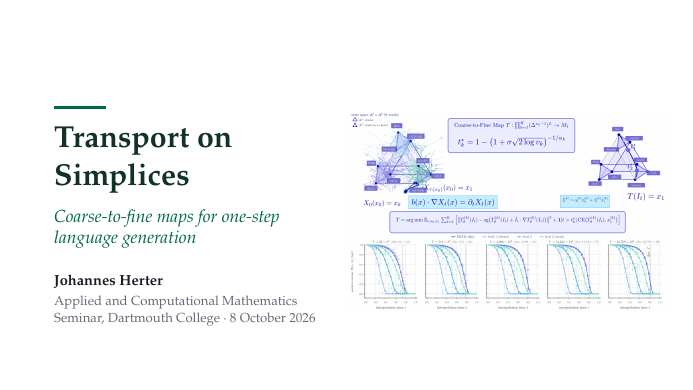
One-Step Generation
Studies one-step language generation with a single time-independent transport field on products of simplices. The flow is shown to reach the data in finite time for every noise schedule, with mean hitting time at most one, and the paper derives a sharp threshold at which each level of a coarse-to-fine token commits. A closed-form schedule exponent raises the share of valid sequences from 51% to 72%.
Illus. Johannes Herter007/007
One-step language generation on products of simplices.
© 2026 JOHANNES HERTER · DISCRETE BECKMANN TRANSPORT ON PRODUCTS OF SIMPLICES
RESEARCHScore GeometryHPk+m
NO. 004 Diffusion Geometry DENOISERS
Jacobians at Density Zeros
Analyzes the Jacobian of the optimal denoiser near a point where the data density vanishes to finite order. In the small-noise limit its range remains the tangent space, but its eigenvalues sum to k + m rather than k, for tangent dimension k and vanishing order m. Calibrating the top k eigenvalues to one recovers the tangent projector.
Illus. Johannes Herter004/007
Tangent geometry of diffusion denoisers at vanishing density.
© 2026 JOHANNES HERTER · SCORE GEOMETRY AT VANISHING DENSITY
RESEARCHRoPE RotationsHPθⱼs
NO. 005 Positional Signals ATTENTION
Rotation-Only Ablations
Determines which rotary frequency pairs a transformer relies on for a given task. Selected rotations are replaced by the identity while the query and key coordinates remain available to the model, which isolates the contribution of the rotation itself. Repeating the ablation across tasks shows how the critical frequency band shifts with the dependency scale a task requires.
Illus. Johannes Herter005/007
Rotation-only ablations of rotary position embeddings across dependency scales.
© 2026 JOHANNES HERTER · ROTATION-ONLY ABLATIONS ACROSS DEPENDENCY SCALES
RESEARCHWalking into HolesHP3D
NO. 006 Topology Design MONTE CARLO
Topological Derivatives
Estimates where inserting a new cavity most improves a PDE-constrained objective. Primal and adjoint walk-on-spheres estimates on the current geometry give the topological derivative without a volumetric mesh. Candidate sites are scored, re-checked with independent samples and then inserted; in a cooling design for a heated Stanford Bunny, this lowers the heat objective by about 47%.
Illus. Johannes Herter006/007
Monte Carlo topological derivatives for grid-free PDE-constrained design.
© 2026 JOHANNES HERTER · WALKING INTO HOLES · MONTE CARLO TOPOLOGICAL DERIVATIVES
PROJECTPersephoneYEAR2026
NO. 001 Persistent Homology TYPESCRIPT WEBGL
Sublevel Sweep
Computes the persistent homology of a grayscale image read as a height function, following the topology of its sublevel sets under a rising threshold. Connected components are tracked by union-find with the elder rule and loops by a second pass through Alexander duality. Persistence diagrams, barcodes and Betti curves are computed in the browser in O(N α(N)) time.
Illus. Johannes Herter001/007
Persistent homology for spatial vision.
© 2026 JOHANNES HERTER · PERSEPHONE · PERSISTENT HOMOLOGY ENGINE
BASICRISC-V PerceptronHP130
NO. 002 Neural Network ASSEMBLY RISC-V
MNIST in RISC-V Assembly
A two-layer perceptron (784–128–10) for handwritten digit classification, written in RISC-V assembly without external libraries. The weights are trained in NumPy and quantized to integers under a bound that rules out 32-bit overflow. The integer network reaches 97.9% accuracy on the MNIST test set, and the assembly output matches a NumPy reference bit for bit.
Illus. Johannes Herter002/007
A multilayer perceptron implemented in RISC-V assembly.
© 2026 JOHANNES HERTER · MLP IN ASSEMBLY · A MULTILAYER PERCEPTRON IN RISC-V ASSEMBLY
BASICSagittarius A*HP250
NO. 003 GRMHD Renderer WEBGL GLSL
GRMHD Visualization
An interactive WebGL visualization of a general-relativistic magnetohydrodynamic accretion flow around Sagittarius A*. Ray-traced radiation snapshots from a public simulation library are displayed as radiation power, magnetic field strength and density in a split view, with shader-drawn iso-contours, adjustable panel boundaries and an orbit camera.
Illus. Johannes Herter003/007
Visualization of a simulated accretion flow around the black hole at the center of the Milky Way.
© 2026 JOHANNES HERTER · SGR A* · GENERAL-RELATIVISTIC MAGNETOHYDRODYNAMIC ACCRETION
Teaching & talks







Talks
Teaching
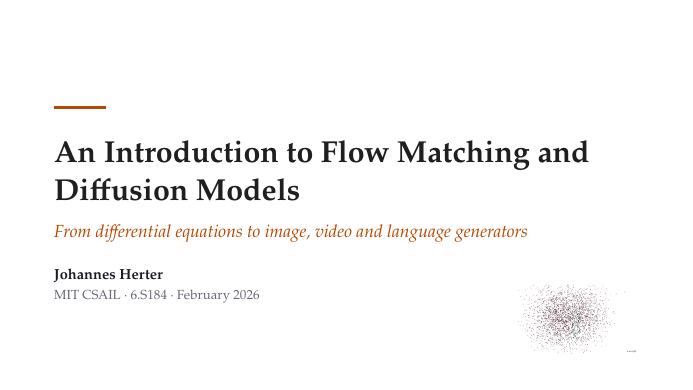
- Feb 2026 · MIT CSAILAn Introduction to Flow Matching and Diffusion ModelsLecture, 6.S184Slides →PDF
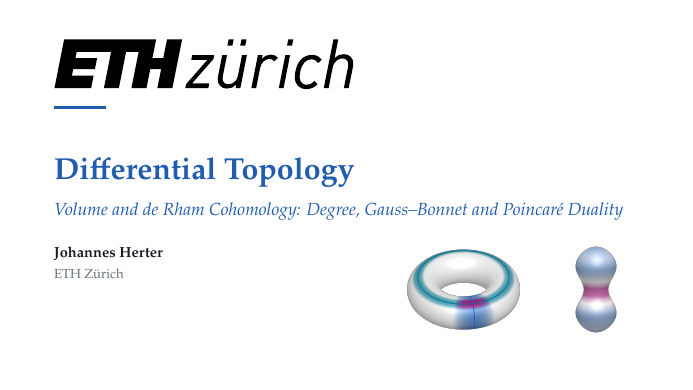
- ETH ZürichDifferential Topology2 lectures
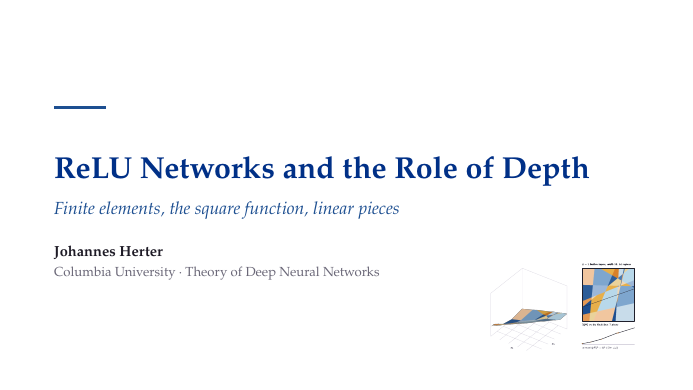
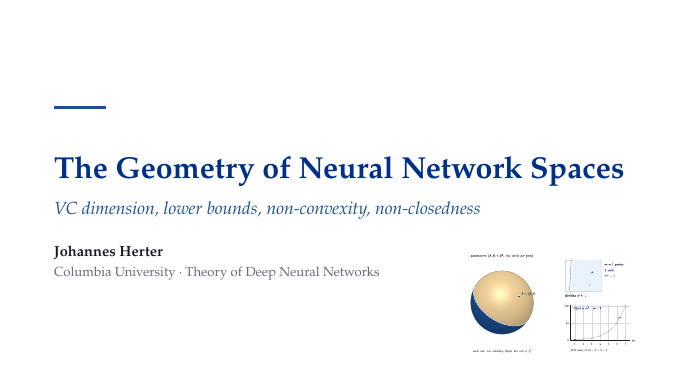
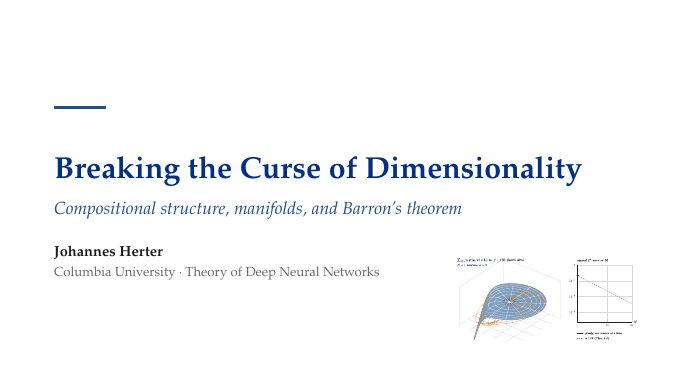
- Nov 2025 · Columbia UniversityTheory of Deep Neural Networks3 lectures
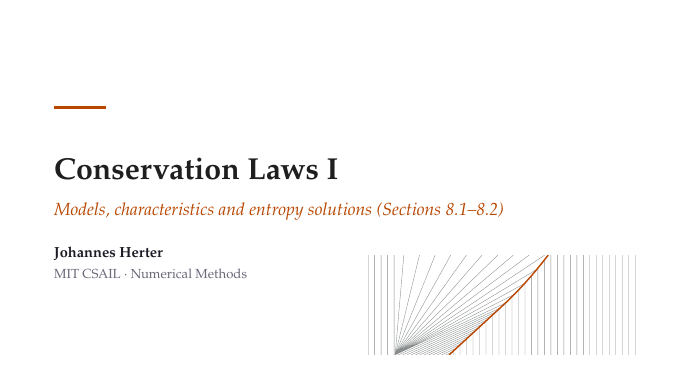
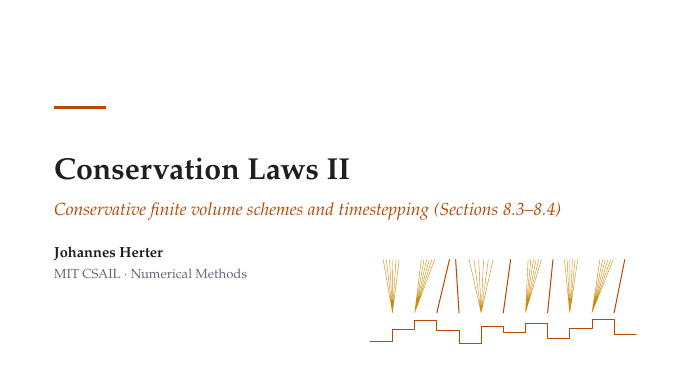
- MIT CSAIL · Introduction to Numerical MethodsConservation Laws3 lectures
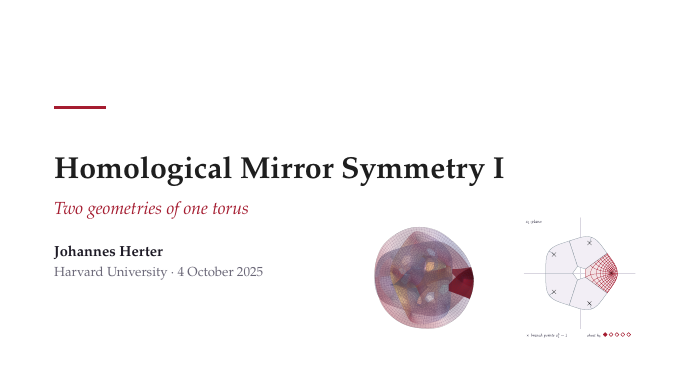
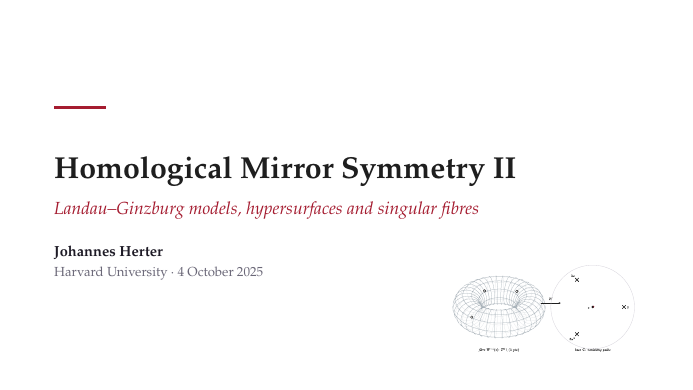
- Oct 2025 · Harvard UniversityHomological Mirror Symmetry2 lectures